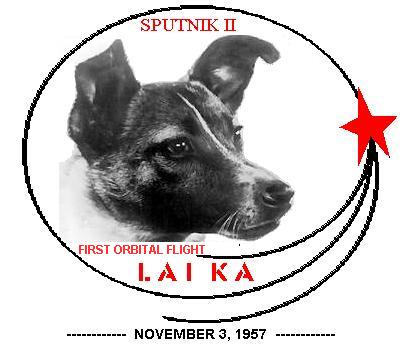
"THE COLD WAR - SPUTNIK - AND SOVIET SPACE DOG LAIKA" Please note - BOLD TYPE IS HISTORICAL and NORMAL TEXT IS FICTIONAL by: Aaron George Bailey - WA5HRC Sherwood, Arkansas USA This Web Page was created on October 4, 2007 CHAPTER #6 LAIKA'S STAR - A DISTANT BEACON ON AN UNCHARTED SEA |
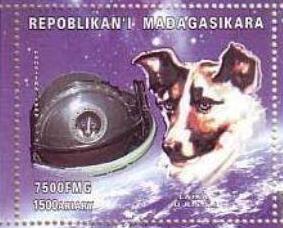
"Good evening North American listeners, this is Moscow calling. Today the Soviet Union successfully
orbited a second earth satellite with a dog as experimental passenger," continued the leading news story
as it crackled over short-wave radios tuned to the world service of Radio Moscow. Only now, after safely
achieving orbit, did the world hear about Sputnik-2. Had it been unsuccessful, would the world have
learned the truth? Because, as history would go on to prove, the Soviets covered up their space
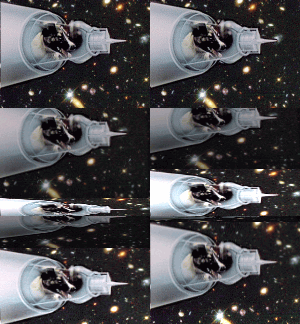
disasters. After orbital insertion, Laika's capsule remained attached to the spent rocket, only the center
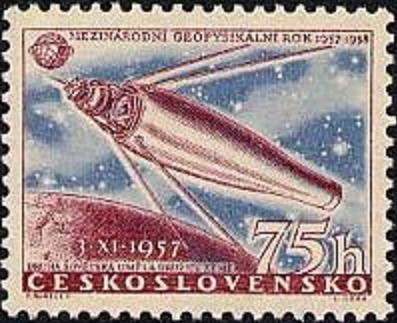
core stage now, and it was still venting out unused propellant. This residue venting had the effect of
uncontrolled steering jets, causing the attitude position of Sputnik-2 to constantly change. The huge
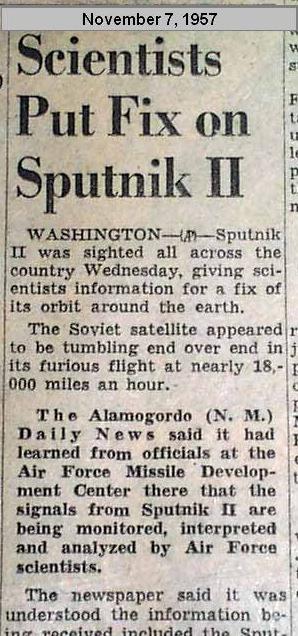
assemblage (508 kilogram mass) began to slowly tumble (once per minute) through the pre-dawn sky,
visible as a pulsating point of light to earth bound observers as it reflected sunlight at different angles. It
was the birth of a new star, Laika's star, as Sputnik-2 glided across the night sky for all to see, not unlike a
distant beacon on an uncharted sea, pointing the way for future manned space flight. From inside the
Sputnik, Laika saw a confusing panorama pass her window, constantly changing blue green brown earth
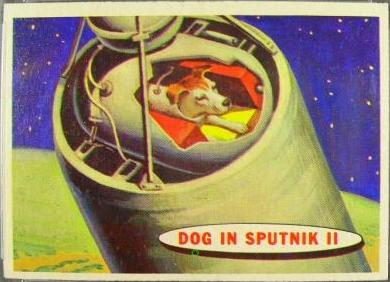
shades followed by a rich star field cast against black, followed by a flash of blinding sunlight. Over and
over the cycle repeated itself while she patiently peered out, watching for her Master. The new Sputnik
announced its presence by radio as it mimicked Sputnik ones electronic voice from a month before. The
beeping rate of its signal was roughly three tenths of a second, as it was heard from Japan.(7) Radio

Moscow announced the spaceship frequencies as being 20.005 MC (one watt beacon) and 40,002 MC
(steady carrier). Short-wave listeners worldwide tuned in the cryptic beeps as they streamed in from outer
space and witnessed firsthand this great accomplishment of Soviet science. The Soviet Union didn't have
a dedicated global network of tracking stations, so the choice of short-wave radio allowed scientists and
peoples of the world, under favorable conditions, to monitor Sputnik signals over great distances,
thousands of miles. For years to come Soviet manned flights would use the same frequencies near 20
megacycles as well, again, mainly because short-wave is not line-of-sight limited. Radio enthusiasts had a
front row seat to Sputnik 2, with its dog passenger, the Soviet Union's newest space show. Some listeners
sent Sputnik 2 reception reports to Radio Moscow and in return received a special QSL card. Once again
the USSR held the high ground of space with its unique satellite capability. In the competitive, tense,
highly charged atmosphere of Cold War politics, Premier Khrushchev gleefully chalked up another space
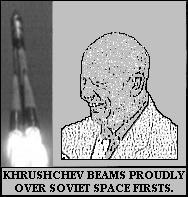
first for the Soviet Union. While American national pride was bruised again as she fell still further behind
in the new cosmic frontier. American public opinion blamed the so called "Missile Gap" on President
Eisenhower and his administration. The Cold War was heating up. During the late Fifties, President
Eisenhower ordered secret overflights of the Soviet Union to size up the Russian missile threat. High
flying U-2 spy planes boldly and routinely penetrated the Soviet Union during this time. On one secret
flyover, the U-2 pilot noticed something interesting in the distance. He changed his coarse and
discovered the R-7 (Sputnik) launching pad at the secret Baikonur Cosmodrome. It was from here that the
R-7 ICBM was being tested. Already poor Soviet/American relations were further aggravated by these U-2
overflights. Such acts were intimating, an insult to Soviet defense forces since the newest Mig fighters
could not even reach them to shoot them down. But now, the technologically conceded Americans got a
double dose of their own medicine as they helplessly gawked up at the Sputniks passing overhead. If U.S.
defense analysts had any uncertainty regarding Soviet ICBM throw weight, it was laid to rest by the orbiting
of Sputnik 2. At 1,120 pounds, this new satellite revealed that the throw weight of the R-7, or SS-6 missile
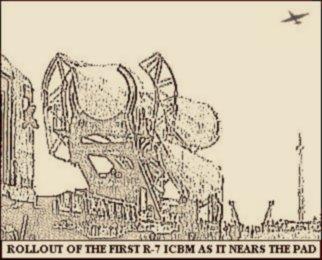
as it was called by NATO, was large enough to hurl thermonuclear bombs right into the heartland of
America. (10) However, what was unknown to Western analysts in 1957 was that a dummy warhead had
fragmented during reentry on the first ICBM test flight in August. In truth a nuclear bomb reentry
technique wasn't perfected by the Soviets until December 1959 when the R-7 ICBM really became
operational as a weapon. Nonetheless, the nuclear tipped ICBM threat to the USA seemed very real in
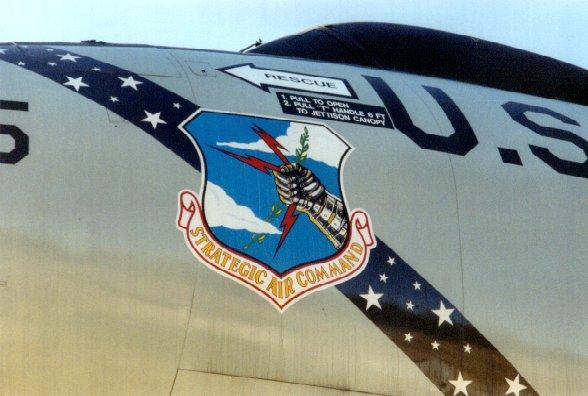
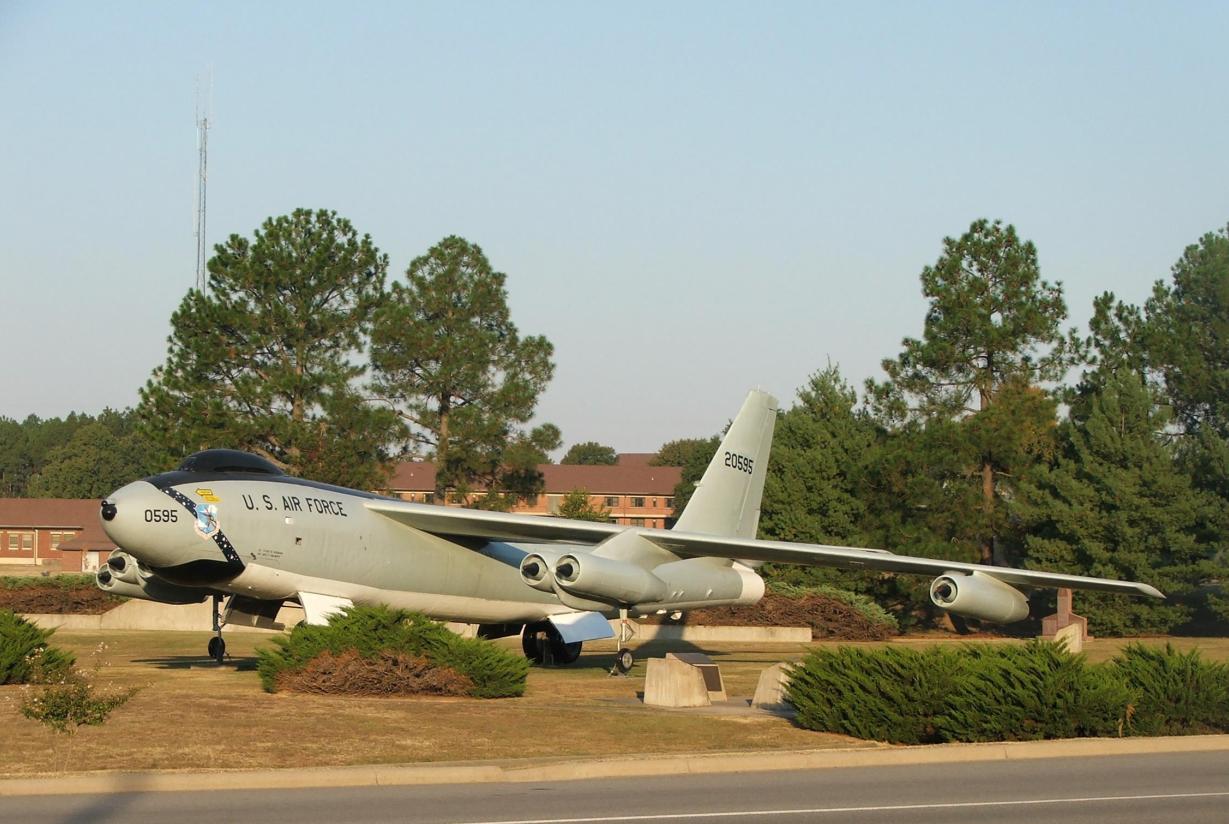
wake of the Sputniks. America's only defense was the offensive might of the Strategic Air Command (SAC)
which honed its state of readiness with war games and by repeatedly firing off alerts. Armed with nuclear
bombs, part of the U.S. Bomber force was kept in the air at all times, on station, patrolling near Russia. So
if war started they were only a couple hours from their assigned targets. The advantage of this delayed
response gave the President an option of recalling the strike force. U.S. Presidents had the technical
means to send “ATTACK” or “RECALL” orders by using a global network of powerful HF radio stations
called “Giant Talk”.^ The B-47 and B-52 Bombers were tuned to the Giant Talk radio net at all times.
However, the new precedence of putting bombs on missiles would ultimately give both nuclear arsenals a
hair trigger. Leaders would have less decision making time, and missiles once launched, could not be
recalled. Once again the world edged closer to nuclear annihilation.

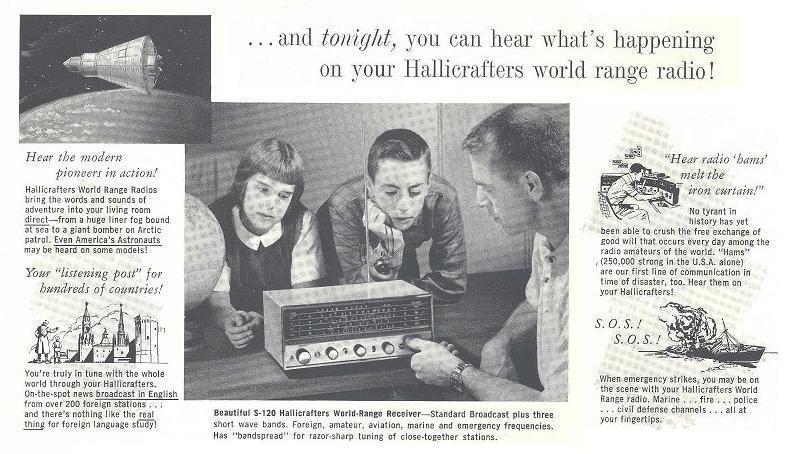
^ As a boy, I had a very modest shortwave set which didn't pull in many stations. But the Giant Talk stations
ran a blistering amount of power and were always heard loud and clear when broadcasting a "SKY KING"
Emergency Action Message-(EAM). Sky King was the group callsign for SAC Bombers in the air, or attack
force, and most of the time they remained radio silent so as not to reveal their position or their numbers.
At a time before communication satellites, the USAF relied heavily on shortwave(HF) radio links with its
aircraft. Giant Talk transmitted frequent test transmissions to verify a good radio circuit with the SAC
Bombers. A typical EAM would go like this-"Sky King, Sky King, do not answer, standby". This outward call
would be repeated several times and then the body of the message would follow, heavily encrypted, and
slowly read out phonetically, ALPHA,,,BRAVO,,,ROMEO,,,FOXTROT,,,ECHO,,, in random 5 letter groups, like,
"ABRFE GINBE KZEON QEEMV,,,,etc". The whole message would be repeated at least two times and
transmitted on a number of frequencies. EAM broadcasts often had an eerie echo sound, perhaps due to
simultaneous transmissions from more than one ground station. EAM transmissions are thought to
contain, "Go to War" or "RECALL-Do Not Go to War" orders. Note- "Dr. Strangelove" is my favorite Cold
War, SAC bomber movie.
| Chapter #7 NEXT - THE BOND BETWEEN A MAN AND DOG - long version - default RETURN TO the HOME PAGE and INDEX |
Aaron George Bailey ----- contact me at email- Laika-on-Sputnik-2@swbell.net
Sherwood, ARkansas USA 72120
Soviet Space History Enthusiast
Aviation and Space Enthusiast
Radio Enthusiast - SWL - Ham operator - WA5HRC - QRP CW
and Dog Lover - See my dog Chipper
Sherwood, ARkansas USA 72120
Soviet Space History Enthusiast
Aviation and Space Enthusiast
Radio Enthusiast - SWL - Ham operator - WA5HRC - QRP CW
and Dog Lover - See my dog Chipper