| MY GENERATION WAS TREATED TO THE MAGIC AND WONDER OF SPACEFLIGHT + MY REACTION TO THE SPACE RACE - AND MY DISCOVERY OF AMATEUR RADIO - AND HOW THEY MERGED INTO A UNIQUE HOBBY by: Aaron George Bailey - WA5HRC |
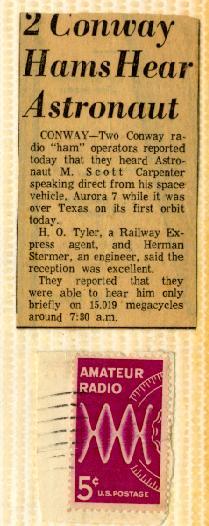
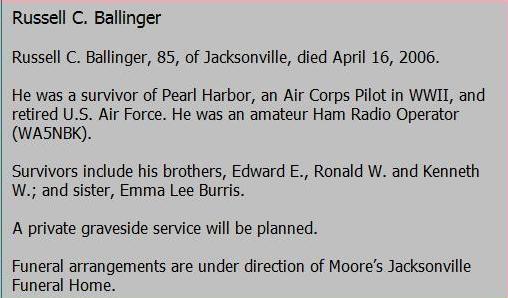
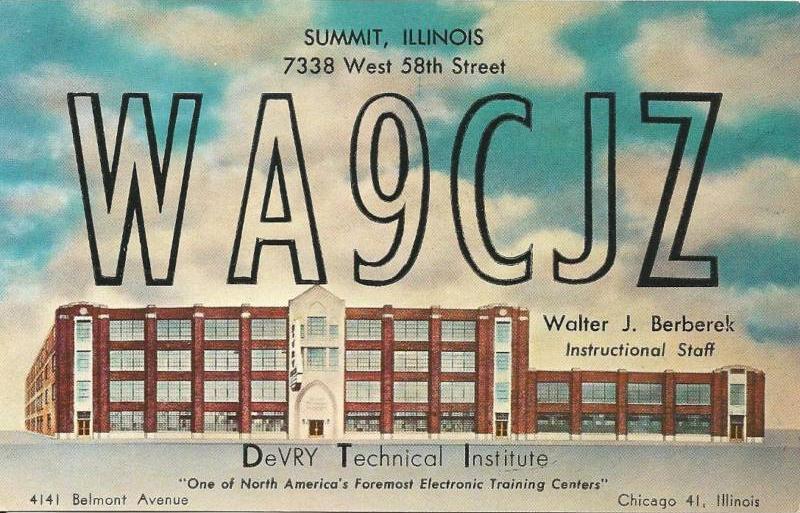
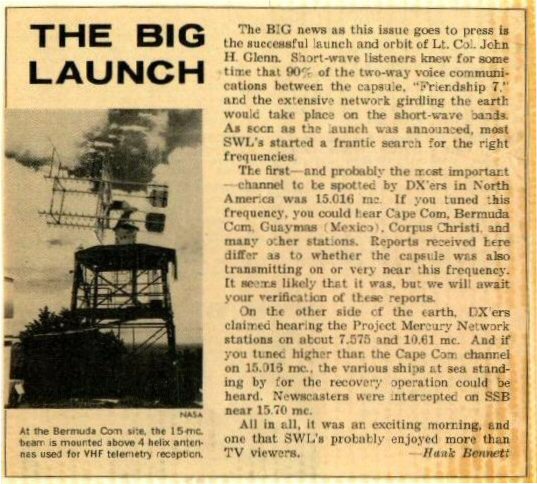
| Listening for spacecraft radio signals has been an ongoing hobby, on and off again, pastime spanning back to the early 1960s. Actually it started out as a sideshow to my interest in Ham radio. This article explains my reaction to spaceflight and my interest in radio and how they merged into a unique hobby. As a youngster, I watched all the Mercury flights on TV, at home or school, when it was a big deal just to get into orbit, and for Mercury Control to even maintain voice contact with the astronauts. Back then there was the dark empire of the Soviet Union and they were bad guys. Their space program was secretive, mysterious, impressive, and by contrast the American program, my team, was struggling, trying to catch up to the Russian space successes. It was good guy verses bad guy and it was all playing out in the heavens, with spaceships that were different, and unique to each sides engineering and technical prowess. The competition between America and Russia seemed to be about survival itself. It could read like a spy novel, and the mix of it all, made a deep impression on me. Unlike any other generation, it was mine that was treated to the magic and wonder of spaceflight. My generation had the same old problems, war, poverty, disease, famine, the same suffering, but it differed in one way, now a gateway was opened to a new, cosmic frontier. Always with a new frontier comes the promise of hope, the expansion of knowledge and a chance to improve the human condition. I was caught up in the special chemistry of the Space Age and Space Race and I wanted to be part of it, in my own way. I thought, by using my own radio gear, how cool it would be to tune in voice transmissions directly from the space capsules. I had read newspaper articles about others doing this and I wanted to give it a try too. During TV coverage of the John Glenn flight, they talked about how his neighbor planned to listen for John, directly, by using a shortwave set. I had a shortwave set too and I remember thinking, "Wow, How neat that would be! ,,, John Glenn must have given his neighbor the capsule frequency in advance?" For me, knowing in advance the capsule frequency was critical, if I hoped to catch weak radio signals from a speeding spaceship. I wrote to NASA requesting frequency information, but they wouldn't tell me. For the first time ever, NASA disappointed me. I was just a kid who wanted to listen to the space shots in a special way. Back then, shortwave radio was like the computers and Internet of today. It was the geeky thing to do. Thousands of ex-radiomen from WWII became Hams and shortwave listeners. This period was the Golden Age of shortwave radio because it seemed that everything crowded onto the HF bands, all kinds of strange sounding signals, teletype, facsimile, Russian jamming stations, and even satellite telemetry. Being a shortwave listener was like being an armchair explorer. Through the magic of electronics, the world was at your fingertips, almost like surfing the Internet today. By using my shortwave radio from the privacy of my home, I hoped to, in effect, enter the space capsule, and for a few fleeting seconds, fly along with the astronaut. And in the case of the Russians, well, I meant to enter their secret spaceship, and spy on them. This was my plan. I hoped shortwave radio would give me a special window, though which I could view spaceflight. Obviously, I needed to learn about radio circuits and radio operating techniques and how to build antennas. These goals also went hand in hand with my desire to get a Ham radio license. At this point I really got fired up with my study of electronics as spaceflight did steer many young people, myself included, toward technical careers. I used the ARRL Amateur Radio Handbook as my study guide. Mr Lyle Armstrong, K5VPM, was in the Signal Corps during WWII and he spent many hours tutoring me on radio theory and sending and receiving morse code. Finally, in mid-1963, I earned my Novice Ham License-call- WN5HRC then, and WA5HRC now, I waited and waited, the FCC, in true bureaucratic fashion, seemed to take forever before mailing me that Ham Ticket. I remember the first time I got on the air and tapped out CQ in morse code, my sending hand was shaking from the excitement, what that code must have sounded like to the poor guy at the other end? A Ham in Texas answered me and helped me through my first contact (QSO) and then followed up by mailing me his QSL card with a nice letter, welcoming me to Ham Radio. With the twist of a few knobs I could convert my Ham radio station to a space listening station. During the early 1960s, I tuned strictly for AM voice transmissions from American and Russian capsules, but I only had a tiny, measured amount of success. It happened like this, once again I wrote letters, to the FCC, and even to shortwave radio manufactures, requesting frequency information on the upcoming space shots. In early May 1963, Hallicrafters Radio Company replied, "Dear Mr Bailey,,,there is a certain amount of sport in searching for the frequency, we suggest you start looking around 10.5 megacycles, since the astronauts have used this before." Back then, when referring to a frequency, you had to qualify it with a prefix of "about" or "around" a certain frequency. see-(What frequency am I tuned to?) With the Gordon Cooper- Faith-7 mission just days away, I began to scout out 10.5 megacycles with the hope of hearing some pre-launch comm checks. My receiver had inaccurate tuning, but immediately I discovered a very strong voice signal that repeated over and over and it was halfway between 10 and 11 megacycles on the radio dial. The SSB voice transmission went like, "This is Comm-Tech Testing, 1,2,3,4,5,5,4,3,2,1," over and over it went.^ I wondered, could this be connected with NASA? I knew that I was on to something, and I felt it in my gut. On launch day, May 15th, after lots of explaining and begging, I convinced my Dad to let me miss school, just so I could tune for Faith-7. I followed the spotty TV coverage so I could focus my listening near stateside passes. I manned my radio at the appropriate time, as always, I tuned around 15MC, and with nothing heard, I finally parked the dial on the endless Comm-Tech transmission. With fading hope I listened, and the Comm-Tech voice played, on and on it went, AND THEN,,, IT STOPPED, "Faith-7, Faith-7, This is California Capcom, Please allow your tape recorder to continue", followed by a noisy signal from Faith-7. I almost fell out of my chair ! I thought I heard the real thing, at the time. But looking back now, I know it was a NASA support channel, 10.61Mhz ?, or more likely the 10.780 Mhz (Cape Radio) that is still in use today. Probably, what I really heard, was a previously recorded, UHF radio exchange between California Capcom and Astronaut Cooper on Faith-7. I was actually hearing a re-broadcast of an earlier orbital pass over California, and by shortwave radio, it was being linked back, possibly to, Cape Canaveral? It was difficult to catch signals from the early manned space shots for several reasons. The first flights were short duration, just a few orbits, and in the case of Mercury flights, they were made on weekdays, when I was in school, and by the time I heard news about a Russian launch, the flight was almost over. In retrospect, online research of NASA documents related to Project Mercury, seem to suggest, that HF (15.009MC) wasn't used very much, and that's what I was tuning for. The UHF was the PRIMARY air-to-ground and HF was SECONDARY or BACKUP air-to-ground. Lastly, while I'm mindful of the old saying, "It's a poor workman who blames his tools", I DID HAVE, cheap, crumby radios, to work with. W5FCM, K5VPM, W5MQR, WA5NBK, all Silent Keys now, were my local Ham friends during this time but none of them were interested in space monitoring. So I listened on my own, just me, with my intriguing articles, no kindred spirit to compare notes with, and no mentor to steer me in the right direction. I wish there had been. I read about other space trackers around the world, the Italian brothers, and the famous Kettering Group from England, but I didn't know how to contact them. For several years, I had to lay aside my radio hobby because life goes on and there were other obligations, electronics school in Chicago, devastating illness in the family, and military service. It wasn't till the early 1970s that I settled down again. But I never lost my love for radio and spaceflight, and the blend of the two, and once again I resumed my hobby. Finally, starting in the early 1970s, a number of factors merged and my space listening hobby got a jump-start. Slowly, I bought new gear, a Radio Shack DX-150B receiver which is SENSITIVE and QUIET, +an Ameco PT-2 Preamp. Most important of all, I built a 1Mhz calibrator, so I could quickly zero in on the old hunting ground of 20Mhz. Early intercepts on 20Mhz shortwave were China 1 & 2 and finally I heard a cosmonaut, AM voice transmission, from Soyuz-14/Salyut-3. I did not discover Soyuz CW-PDM telemetry till a bit later. >SEE BOOK In July 1975, with my radio gear, I made a trip to Florida and watched live the Apollo-Soyuz launch from Titusville. I also received the Apollo countdown activities on 296.8Mhz by using a Vanguard Converter ahead of my SW radio. So, I have a record of mixed results and there are gaps in my observations and for this reason other observers might have a different and broader point of view. I was a serious observer, all along, recording my radio intercepts and logging my results on paper and on the 300+ tapes I filled. While I was in a unique position, geographically, to electronically monitor Soviet space, I feel it wasn't as good as being located in Europe, near to Russia. From that vantage point you could electronically look right into the heart of Russia. When located near to Soviet territory, one could hear satellite transmitters as they were commanded on by Russian ground stations, and Cosmonauts were more active on the radio, and some East German radio spies actually heard satellite signals from the Baikonur launching pad. I too tried to look inside Russia by building a 2 element cubical quad, a special beam antenna designed for 20mhz. It was my electronic ear, aimed toward Russia. It pulled in the faint telemetry signals from Soyuz-39 just after it was inserted into orbit from Baikonur Cosmodrome. With the Quad I also picked up a mystery signal, a broken CW-PDM without the sync-pulses. However, I'm not sure this was a space related signal? -(see my other antennas) My radio tracking reached a high point during the Salyut-6, Salyut-7 and Mir era, when there were plenty of signals to hear. In later years, after searching with the power of the Internet, I now realize that I was just one, in a handful of space enthusiasts, who were actively engaged in this hobby. While my overall work is not as remarkable as others, I feel this web page documents my efforts in fair and truthful way. ^ There was a reason why NASA transmitted the powerful Comm-Tech around-the-clock. It was a way to secure that frequency, or maintain a clear channel, by keeping unauthorized (foreign and pirate) stations off of it. This was a common strategy used by AT&T and RCA who also transmitted repeating test messages, like-"This is an AT&T test transmission for circuit adjustment purposes." |
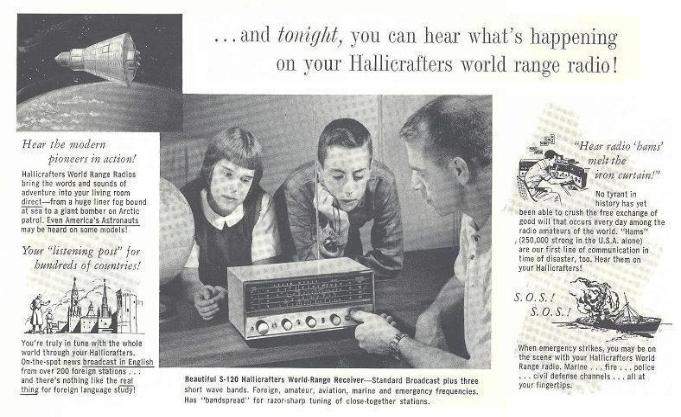
1962 Ad